Home › Autism › Does Lack of Eye Contact Always Mean Autism? What Parents Need to Know
Does Lack of Eye Contact Always Mean Autism? What Parents Need to Know
Answer
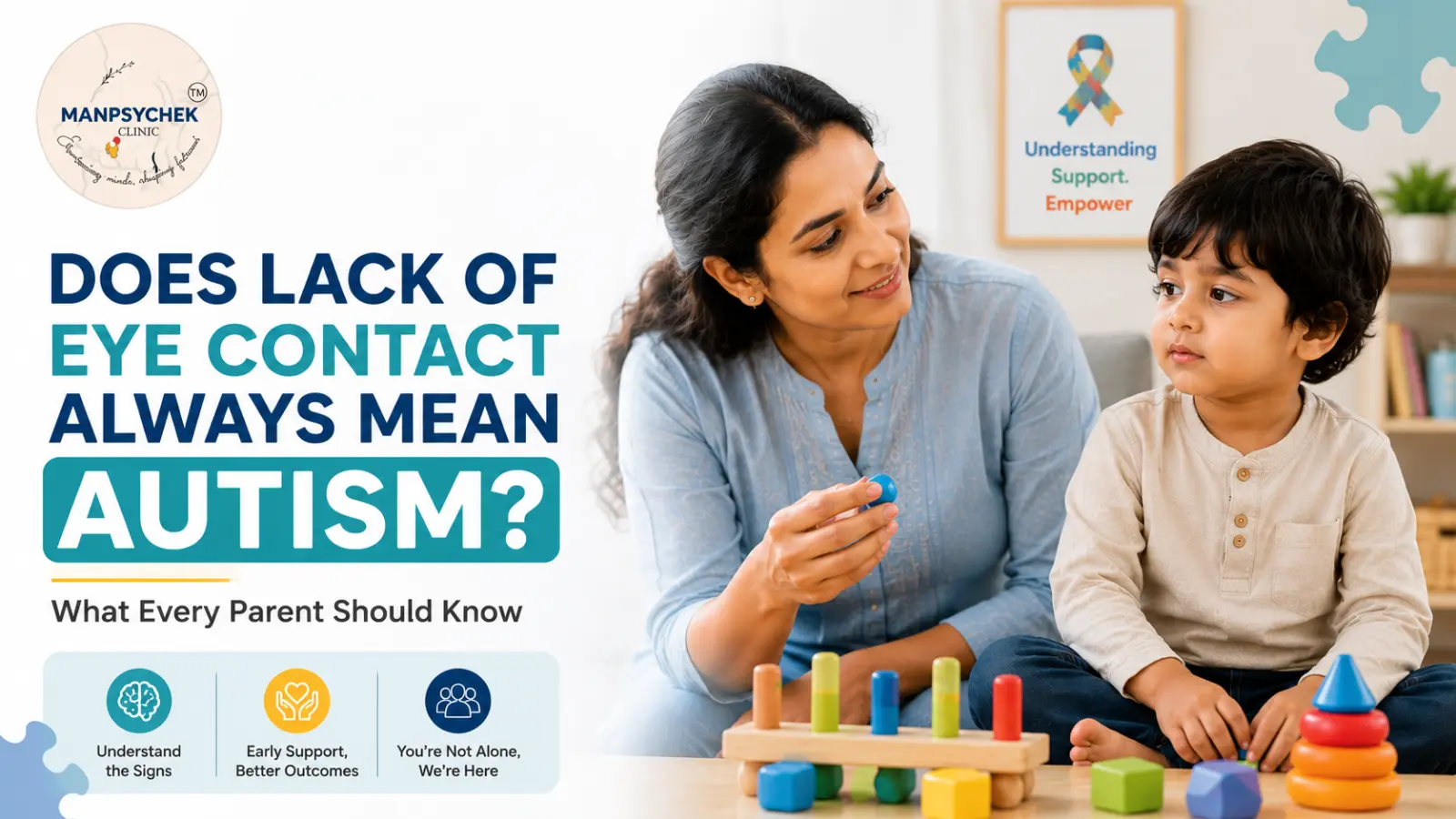
No. Lack of eye contact does not always mean a child has autism. Some children avoid eye contact because of shyness, anxiety, sensory sensitivities, developmental differences, or individual temperament. However, reduced eye contact combined with delayed communication, social difficulties, repetitive behaviors, or developmental delays may indicate the need for a professional developmental assessment.
Can Autism Be Detected Before Age 2? Early Signs Every Parent Should Know
Why Does My Child Keep Repeating Words? Understanding Echolalia in Children
Important: Eye contact should always be interpreted within the context of a child's overall development, communication skills, social interaction, and behavior patterns.
Introduction
One of the most common concerns parents bring to child development professionals is:
"My child doesn't make eye contact. Does that mean they have autism?"
Perhaps your toddler looks away when you speak to them. Maybe they rarely look directly at people during conversations. Or a teacher may have mentioned concerns about your child's social interaction at school.
It is natural to feel worried when your child behaves differently from other children.
The good news is that reduced or inconsistent eye contact alone does not automatically mean a child has Autism Spectrum Disorder (ASD).
While eye contact differences can be one characteristic associated with autism, there are many other reasons a child may avoid or reduce eye contact.
Understanding why eye contact matters, what influences it, and when parents should seek professional guidance can help families make informed decisions without unnecessary fear.
What Is Eye Contact and Why Is It Important?
Eye contact is a fundamental part of social communication.
From infancy, children learn about the world by observing faces, expressions, emotions, and social cues.
Eye contact helps children:
- Build relationships
- Understand emotions
- Learn social skills
- Participate in conversations
- Develop communication abilities
- Share attention and interests with others
However, eye contact develops gradually and naturally varies from child to child.
Some children are naturally more socially expressive, while others may be quieter or more reserved.
Does Reduced Eye Contact Always Mean Autism?
No.
Reduced eye contact alone cannot diagnose autism.
Autism Spectrum Disorder is a neurodevelopmental condition characterized by differences in:
- Social communication
- Social interaction
- Behavior
- Sensory processing
According to the DSM-5, an autism diagnosis requires persistent differences in social communication and social interaction, along with restricted or repetitive patterns of behavior, interests, or activities.
Eye contact is only one small part of a much larger developmental picture.
A child who occasionally avoids eye contact but demonstrates strong language skills, age-appropriate social interaction, pretend play, and emotional understanding may not have autism.
Common Reasons Children Avoid Eye Contact
There are many reasons why a child may avoid eye contact.
1. Temperament and Personality
Some children are naturally shy, cautious, or reserved.
These children may:
- Take longer to warm up to new people
- Avoid direct eye contact with strangers
- Prefer observing before interacting
This can be a normal personality trait rather than a developmental concern.
2. Social Anxiety
Children who feel nervous in social situations may avoid direct eye contact.
This is especially common in:
- School-aged children
- Adolescents
- Children experiencing social anxiety
In these situations, avoiding eye contact is often related to discomfort rather than autism.
3. Sensory Sensitivities
For some children, eye contact can feel overwhelming.
Direct eye contact involves processing:
- Facial expressions
- Emotional information
- Visual stimulation
Children with sensory sensitivities may look away to reduce sensory overload.
4. Language Delays
Children who struggle to understand or use language may appear less socially engaged.
They may avoid eye contact because communication itself feels difficult.
5. Attention Difficulties
Children with ADHD or attention-related challenges may appear distracted and may not consistently maintain eye contact during conversations.
6. Autism Spectrum Disorder
Reduced eye contact can be one characteristic associated with autism.
However, autism involves much more than eye contact alone.
Children with autism often show differences in several developmental areas simultaneously.
Signs That May Be More Concerning
Parents should consider whether reduced eye contact occurs alongside other developmental differences.
These may include:
Delayed Speech and Language
- Few words for age
- Difficulty expressing needs
- Delayed communication milestones
Poor Response to Name
The child does not consistently respond when called.
Limited Social Interaction
- Prefers being alone
- Limited interest in peers
- Difficulty engaging in social games
Reduced Use of Gestures
Examples include:
- Pointing
- Waving
- Showing objects
Repetitive Behaviors
Such as:
- Hand flapping
- Lining up toys
- Repeating phrases
- Spinning objects
Sensory Sensitivities
Strong reactions to:
- Loud sounds
- Bright lights
- Certain textures
- Specific food textures
When several of these signs occur together, professional assessment may be beneficial.
Parent Observation Checklist
Use this simple checklist to observe your child's development.
| Observation | Yes | No |
|---|---|---|
| Responds to name consistently | □ | □ |
| Makes eye contact during familiar interactions | □ | □ |
| Uses age-appropriate language | □ | □ |
| Points to show interest | □ | □ |
| Engages in pretend play | □ | □ |
| Enjoys social interaction | □ | □ |
| Uses gestures to communicate | □ | □ |
| Shows interest in sharing experiences | □ | □ |
Remember, one behavior rarely tells the whole story.
Looking at overall development provides a more accurate picture.
Scientific Explanation
Research shows that eye contact involves multiple areas of brain function, including:
- Social attention
- Emotional processing
- Communication
- Sensory integration
Children naturally vary in how much eye contact they use.
In autism, reduced eye contact may be related to differences in social attention and social information processing.
However, researchers emphasize that eye contact exists on a spectrum and should never be used as a standalone indicator of autism.
Risk Factors Associated with Autism
While reduced eye contact itself is not a risk factor, autism may be more likely in children with:
- Family history of autism
- Premature birth
- Low birth weight
- Certain genetic conditions
- Developmental delays
- Sensory processing differences
Risk factors increase likelihood but do not determine outcomes.
Age-Wise Understanding of Eye Contact
Birth to 6 Months
Most infants begin making eye contact and engaging socially with caregivers.
6 to 12 Months
Babies typically:
- Look at faces
- Smile socially
- Share attention
- Respond to familiar people
12 to 24 Months
Children usually:
- Use eye contact during communication
- Follow pointing gestures
- Share interests with caregivers
Preschool Years
Eye contact becomes increasingly important for social interaction, play, and communication.
Real-Life Parent Example
A family visited K.S MannpsycheK Dwarka Mor because they were concerned about their four-year-old son's eye contact.
The child often looked away when speaking to unfamiliar adults.
The parents feared this meant autism.
After a comprehensive developmental assessment, it became clear that the child:
- Had age-appropriate language
- Enjoyed pretend play
- Had several friends
- Understood emotions
- Engaged socially with family members
His reduced eye contact appeared related to shyness and social anxiety rather than autism.
In contrast, another child with reduced eye contact also had speech delays, repetitive behaviors, sensory sensitivities, and significant social communication challenges.
Further assessment supported an autism diagnosis.
The difference was not eye contact alone.
The difference was the overall developmental profile.
Myths vs Facts
| Myth | Fact |
|---|---|
| Lack of eye contact always means autism | False |
| Some children naturally avoid eye contact | True |
| Autism diagnosis requires multiple symptoms | True |
| Eye contact varies between individuals | True |
| Early assessment can provide clarity | True |
| Reduced eye contact alone confirms autism | False |
How Reduced Eye Contact Can Affect Development
If reduced eye contact occurs alongside developmental challenges, difficulties may arise in:
Communication
Understanding and responding to social communication cues.
Social Skills
Building friendships and participating in group activities.
Learning
Understanding classroom instructions and social expectations.
Emotional Understanding
Recognizing facial expressions and emotional cues.
Assessment and Diagnosis
If concerns exist, a professional developmental evaluation may include:
Developmental History
Reviewing milestones and parent observations.
Parent Interviews
Understanding behavior across home, school, and social settings.
Clinical Observation
Assessing communication, play, behavior, and interaction.
Standardized Assessments
Using evidence-based developmental tools.
Multidisciplinary Evaluation
Professionals may include:
- Child Psychologist
- Developmental Pediatrician
- Speech Therapist
- Occupational Therapist
- Special Educator
Treatment and Support Options
If developmental concerns are identified, support may include:
Autism Assessment and Intervention Services
Individualized developmental support based on a child's strengths and needs.
ABA Therapy
Evidence-based interventions that support communication, learning, and adaptive skills.
Speech Therapy
Improves communication, language development, and social interaction.
Occupational Therapy
Supports sensory processing and daily living skills.
Special Education
Provides individualized educational support.
Behavior Therapy
Helps develop adaptive behaviors and emotional regulation skills.
Home Strategies for Parents
Stay Calm
Avoid assuming the worst based on a single behavior.
Focus on Connection
Spend quality time engaging with your child through play and conversation.
Encourage Communication
Respond positively to all communication attempts.
Reduce Pressure
Avoid forcing eye contact, as this can increase anxiety.
Monitor Development
Observe language, social interaction, play skills, and emotional development over time.
When Should Parents Seek Professional Help?
Consider seeking professional guidance if reduced eye contact occurs alongside:
- Speech delays
- Poor response to name
- Limited social interaction
- Repetitive behaviors
- Sensory sensitivities
- Developmental regression
- Delayed milestones
Early assessment can provide clarity, reassurance, and access to appropriate support.
Professional Support at MannpsycheK
At MannpsycheK, under the guidance of Dr. Saurav Deep, families receive evidence-based developmental assessments and intervention services.
Our services include:
- Autism Assessment
- Autism Assessment and Intervention Services
- ABA Therapy
- Speech Therapy
- Special Education
- Learning Disability Assessment
- ADHD Assessment
- Behavior Therapy
- Developmental Screening
- Parent Guidance and Counseling
Families seeking a Child Psychologist in Dwarka, developmental assessment, or autism screening can access comprehensive evaluations and personalized support plans.
Conclusion
Reduced or inconsistent eye contact does not automatically mean autism.
Many factors influence eye contact, including personality, anxiety, sensory processing, communication abilities, and developmental stage.
Parents should focus on the child's overall development rather than a single behavior.
When concerns exist, professional assessment can provide reassurance, guidance, and early support when needed.
The goal is not to label a child but to better understand their unique developmental needs and provide the right support at the right time.
Book a Developmental Assessment at MannpsycheK
If you are concerned about your child's eye contact, communication, behavior, or developmental milestones, professional guidance can help.
At K.S MannpsycheK Dwarka Mor, we provide:
✔ Autism Assessment
✔ ABA Therapy
✔ Speech Therapy
✔ Special Education Services
✔ Learning Disability Assessment
✔ ADHD Assessment
✔ Behavior Therapy
✔ Parent Counseling
Book a consultation today and gain clarity about your child's developmental strengths, challenges, and support needs.
Frequently Asked Questions
Q1. Does lack of eye contact always mean autism?
A1. No. Lack of eye contact alone does not automatically indicate autism. Many children avoid eye contact because of shyness, anxiety, sensory sensitivities, personality traits, or developmental stage. Autism is diagnosed based on a broader pattern of social communication differences and repetitive behaviors, not on eye contact alone.
Q2. At what age should a child make eye contact?
A2. Most babies begin making eye contact within the first few months of life. By 6 months, many infants regularly engage with caregivers through eye contact, smiling, and social interaction. However, development varies between children, and occasional differences are not always a cause for concern.
Q3. Can a child have autism and still make eye contact?
A3. Yes. Many autistic children and adults can make eye contact. Some may use eye contact inconsistently, while others may learn to use it effectively in social situations. Eye contact alone should never be used to determine whether someone has autism.
Q4. What other signs should parents watch for besides reduced eye contact?
A4. Parents should observe speech and language development, response to name, social interaction, pretend play, use of gestures, sensory sensitivities, repetitive behaviors, and developmental milestones. Looking at the overall developmental picture provides more useful information than focusing on one behavior.
Q5. When should I seek a professional assessment?
A5. A professional assessment may be helpful if reduced eye contact occurs alongside speech delays, social communication difficulties, repetitive behaviors, sensory sensitivities, developmental regression, or concerns raised by caregivers or teachers. Early evaluation can provide clarity and support.