Home › Guidance For Parents › Autism vs ADHD: How Parents Can Tell the Difference
Autism vs ADHD: How Parents Can Tell the Difference
Answer
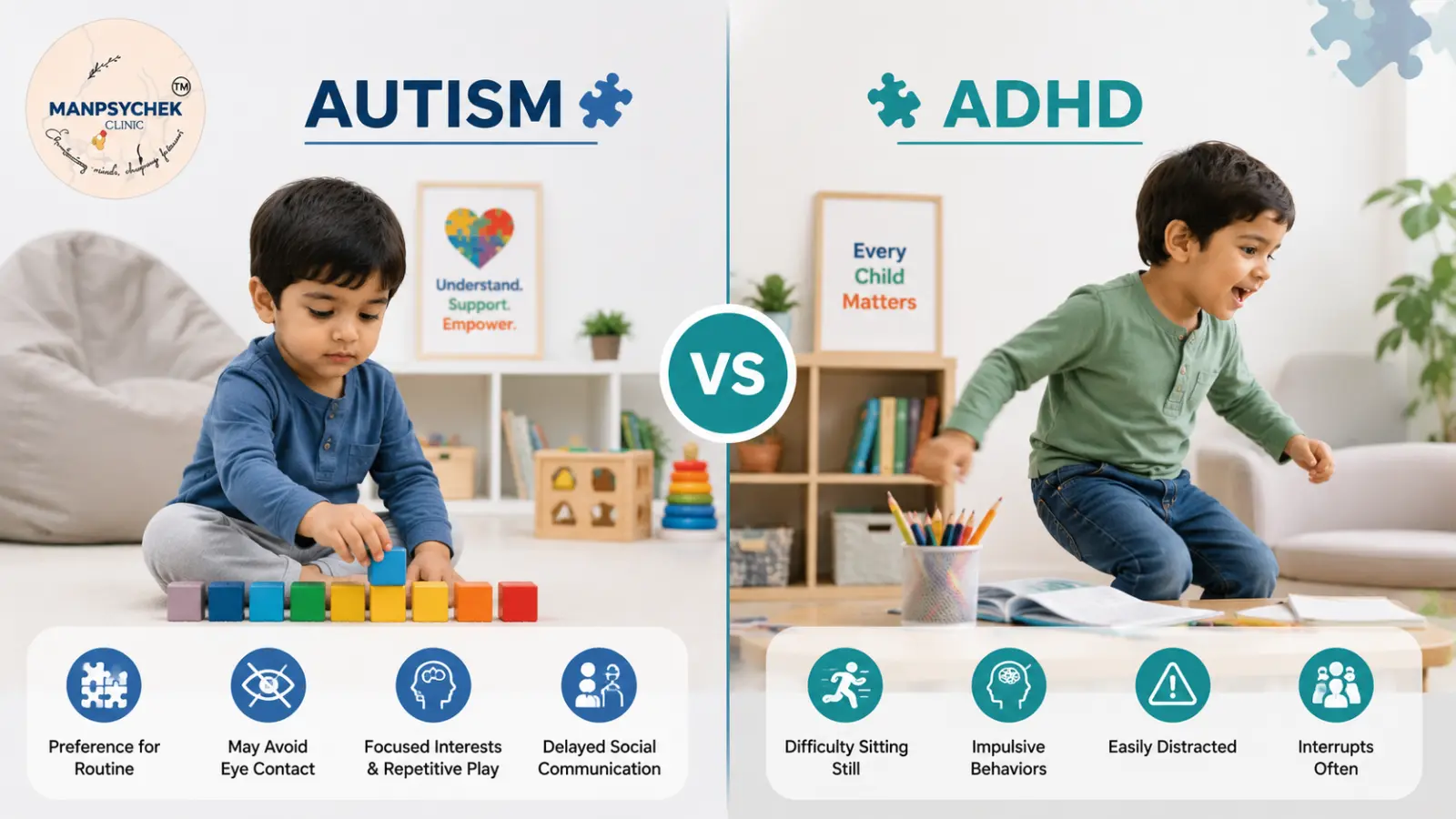
Autism and ADHD are both neurodevelopmental conditions, but they affect children in different ways. Autism usually involves differences in social communication, eye contact, play, and repetitive behaviors, while ADHD mainly affects attention, impulsivity, and activity level. Some children can have both conditions, so a professional assessment is the safest way to tell the difference.
ADHD Symptoms in 3-Year-Olds: Signs, What’s Normal & When to Seek Help
Is My 2 Year Old Showing Signs of Autism? Early Symptoms Parents Should Never Ignore
Introduction
Many parents first notice something is “off” when their child is not responding the way other children do. Maybe your child does not sit still. Maybe they do not listen. Maybe they avoid eye contact. Maybe the teacher says your child is impulsive, while a relative says the same child “acts autistic.” That confusion is common, and it is exactly why this topic matters. Autism and ADHD can look similar on the surface, but they are not the same condition. Autism is mainly about social communication differences and restricted or repetitive behaviors, while ADHD is mainly about inattention, hyperactivity, and impulsivity.
The problem is not the label. The problem is guessing incorrectly and then treating the wrong issue. A child with autism may need support with social communication, flexible play, sensory regulation, speech, and learning. A child with ADHD may need support with attention, self-control, structure, behavior routines, and school accommodations. Some children have both, so one rule of thumb is not enough.
What Is Autism?
Autism Spectrum Disorder (ASD) is a neurological and developmental disorder that affects how people interact, communicate, learn, and behave. Signs often appear in the first two years of life, and autism is diagnosed using developmental history and behavior rather than a blood test. Common signs include little or inconsistent eye contact, not responding to name, limited sharing of interest or emotion, difficulty with back-and-forth conversation, repetitive behaviors, lining up toys, and strong reactions to change or sensory input.
What Is ADHD?
ADHD is a developmental disorder marked by persistent inattention, hyperactivity, and impulsivity. Children with ADHD may have trouble paying attention, controlling impulses, sitting still, waiting their turn, or staying organized. ADHD is usually first diagnosed in childhood and can continue into adulthood.
Autism vs ADHD: The Core Difference
A simple way to think about it is this:
- Autism = differences in social communication + repetitive/restricted patterns of behavior.
- ADHD = difficulty regulating attention, activity level, and impulses.
That sounds neat on paper. Real life is messier.
A child with autism may seem inattentive because they are focused on their own internal world, sensory issues, or a preferred routine. A child with ADHD may seem socially clumsy because they interrupt, miss cues, or act before thinking. The behavior can look similar, but the underlying pattern is different. Some children also have both conditions, which makes the picture even more confusing.
Symptoms and Signs
Signs more commonly seen in autism
Children with autism may show:
- Little or inconsistent eye contact
- Not responding to name consistently
- Not pointing to share interest
- Delayed social communication
- Limited pretend play
- Repetitive play like lining up toys
- Hand flapping, rocking, or spinning
- Strong need for routines
- Sensory sensitivities to sound, light, touch, smell, or taste
Signs more commonly seen in ADHD
Children with ADHD may show:
- Difficulty paying attention
- Forgetting instructions
- Fidgeting
- Talking excessively
- Interrupting others
- Acting without thinking
- Trouble waiting or staying seated
Where parents get confused
A child with autism may ignore their name because of social communication differences. A child with ADHD may ignore their name because they are distracted. A child with autism may seem restless because of sensory overload. A child with ADHD may seem restless because of impulsivity. The surface behavior is not enough. You have to ask what is driving it.
Quick Comparison Table
| Area | Autism | ADHD |
|---|---|---|
| Eye contact | Often reduced or inconsistent | Usually present, but may be poorly sustained because of distraction |
| Social communication | Core difficulty | May be affected, but not the core feature |
| Attention | Can be selective, especially for preferred interests | Core difficulty |
| Impulsivity | May occur, but not central | Core feature |
| Repetitive behaviors | Common | Not a defining feature |
| Sensory sensitivities | Common | Can happen, but less central |
| Response to routines | Often strong need for sameness | More trouble with consistency than sameness |
| Play style | May be repetitive or unusual | Often active, but disorganized |
| Onset | Signs often in first two years | Symptoms start in childhood |
Causes and Risk Factors
Neither autism nor ADHD is caused by bad parenting. That idea is outdated and harmful.
Autism is a developmental disability with signs that are often recognizable in early childhood. ADHD is also a common neurodevelopmental disorder of childhood. Both conditions are shaped by brain development and multiple biological factors; the exact causes are not reduced to a single parenting mistake or one simple trigger.
Risk can run in families, and co-occurring conditions are common. CDC data notes that many children with ADHD have other co-occurring conditions, including autism spectrum disorder, which is why a proper assessment matters instead of a guess based on one or two behaviors.
Scientific Explanation
Autism and ADHD are both neurodevelopmental conditions, which means they affect how the brain develops and functions. Autism is defined by persistent social communication differences and restricted/repetitive behaviors. ADHD is defined by inattention and/or hyperactivity-impulsivity. Because both involve brain-based regulation differences, children can look similar in daily life even when the underlying condition is different.
This is why a child who “does not listen,” “cannot sit still,” or “does not talk much” should not be labeled quickly. One symptom does not equal a diagnosis. A clinician looks at the full pattern, developmental history, home and school behavior, and how the child functions socially and emotionally. CDC notes that autism diagnosis is based on developmental history and behavior, and there is no blood test for it.
Age-Wise Breakdown
Under 2 years
Autism signs may become noticeable in the first two years of life, including reduced eye contact, limited pointing, reduced sharing of interest, delayed speech, or repetitive behaviors. ADHD is usually harder to diagnose this early because activity and attention patterns are still developing.
Ages 2 to 5
This is often the age when the difference starts becoming clearer. Autism concerns may show up in social interaction, pretend play, sensory issues, and repetitive behavior. ADHD concerns may show up as high activity, impulsivity, difficulty following instructions, and poor regulation.
School age
At school, ADHD often becomes more visible because demands for attention, sitting still, and completing tasks increase. Autism may also become clearer through social communication challenges, rigidity, sensory issues, or difficulty adapting to classroom routines.
Real-Life Parent Example
A parent brought their 4-year-old child to K.S MannpsycheK Dwarka Mor because the teacher said the child could not sit still, interrupted constantly, and forgot instructions. The parents also noticed the child was very active at home. On assessment, the child showed strong eye contact, age-appropriate pretend play, and good sharing of interest, but clear attention and impulse-control difficulties. That pattern fit ADHD more than autism.
In another case, a child seemed quiet and “not listening,” but the real issue was reduced eye contact, limited pointing, repetitive play, sensory sensitivity, and weak social reciprocity. That pattern pointed toward autism. The behaviors overlapped, but the reasons were different.
Myths vs Facts
| Myth | Fact |
|---|---|
| Autism and ADHD are the same | False |
| A child can have both | True |
| Poor focus always means ADHD | False |
| Poor eye contact always means autism | False |
| Repetitive behavior is common in autism | True |
| Inattention can happen in both conditions | True |
| One behavior can confirm a diagnosis | False |
| Early assessment helps | True |
Assessment and Diagnosis
A proper assessment looks at the child as a whole, not one symptom in isolation. For autism, CDC notes diagnosis is based on developmental history and behavior, and autism screening is part of routine developmental and behavioral screening during well-child visits. The CDC notes AAP screening ages of 9, 18, and 30 months. For ADHD, diagnosis also requires a clinical process, symptom review, and understanding how the child functions at home and school.
A good assessment may include:
- Parent interview
- Teacher input
- Developmental history
- Clinical observation
- Speech and language review
- Behavioral evaluation
- Learning and school readiness review
- Sensory profile if needed
At Mannpsychek / K.S MannpsycheK Dwarka Mor, this is where a Child Psychologist in Dwarka can help families avoid guessing and move straight to clear, practical answers.
Treatment Options
For autism, CDC notes that early intervention services can greatly improve a child’s development, and speech and language therapy is the most common developmental therapy for ASD. For ADHD, CDC notes that behavior therapy is effective, and for young children it is the first line before medication; for older children, treatment may include behavior therapy and medication, along with school supports.
In practical clinic terms, support may include:
- Autism assessment and intervention
- ABA Therapy
- Speech Therapy
- Special Education
- Learning Disability Assessment
- ADHD Assessment
- Behavior Therapy
- Parent training
- School consultation
That is the kind of multidisciplinary care families need when the signs are not obvious.
Home Strategies for Parents
Do not start by fighting the label. Start by observing behavior patterns.
Helpful steps at home:
- Track what you notice, when it happens, and what triggers it.
- Notice whether the child shares attention, points, responds to name, and engages in pretend play.
- Reduce pressure during interaction.
- Use short, clear instructions.
- Keep routines predictable.
- Share concerns with school and a qualified professional early.
For autism concerns, focus on communication and social engagement. For ADHD concerns, focus on structure, consistency, and behavior support. For both, consistency matters more than parental guilt.
Professional Intervention
At Mannpsychek, Dr. Saurav Deep and the team support families through evidence-based developmental assessment and intervention. Services include Autism Assessment, ADHD Assessment, Speech Therapy, ABA Therapy, Special Education, Learning Disability Assessment, Behavior Therapy, and parent guidance.
If you are in Delhi and searching for Autism Therapy, ABA Therapy, Speech Therapy, or ADHD Assessment, the next step should not be online self-diagnosis. It should be a proper developmental evaluation.
Conclusion
Autism and ADHD can both affect a child’s behavior, attention, learning, and relationships, but they are not the same condition. Autism usually shows up in social communication differences, repetitive behaviors, and sensory or routine-related issues. ADHD usually shows up as inattention, hyperactivity, and impulsivity. Some children have both. That is why a careful assessment matters more than guessing from one symptom.
Parents do not need to become experts overnight. They need clarity. If something feels off, trust the concern, not the confusion.
If you are worried about your child’s attention, behavior, eye contact, social interaction, speech, or learning, book an assessment at Mannpsychek / K.S MannpsycheK Dwarka Mor.
Frequently Asked Questions
Q1. How do I know if my child has autism or ADHD?
A1. Autism and ADHD can both affect behavior, but they usually show different patterns. Autism is more about social communication, eye contact, pretend play, repetitive behavior, and sensory differences. ADHD is more about attention, impulsivity, and high activity. A child can also have both. A clinical developmental assessment is the safest way to tell the difference.
Q2. Can autism be mistaken for ADHD?
A2. Yes. A child with autism may appear distracted, not listening, or overly active because of sensory overload, rigid routines, or communication difficulty. That can look like ADHD from the outside. But autism also includes social communication differences and repetitive behaviors, which helps separate it from ADHD. An experienced evaluator looks at the full developmental picture, not one behavior alone.
Q3. Can a child have both autism and ADHD?
A3. Yes. CDC notes that autism is one of the co-occurring conditions seen in children with ADHD. Some children show both sets of symptoms, which is why the evaluation needs to be detailed and not rushed. When both are present, the child may need a blended support plan for behavior, learning, communication, and social development.
Q4. What age can autism or ADHD be diagnosed?
A4. Autism signs can often be noticed in early childhood, and diagnosis is generally possible by age 2, while routine developmental screening is recommended during well-child visits at 9, 18, and 30 months. ADHD is usually first diagnosed in childhood and symptoms often continue into adulthood. The exact timing depends on the child and the level of concern.
Q5. What should I do first if I suspect autism or ADHD?
A5. Do not wait for the child to “grow out of it” if concerns are affecting daily life. Start with a developmental assessment by a qualified professional. Bring examples from home and school, note when the behaviors happen, and ask for guidance on speech, behavior, learning, and social development. Early support is linked with better outcomes, and it is better to act early than guess late.
ABOUT THE AUTHOR
Dr. Saurav Deep
Director, K.S MannpsycheK, Dwarka Mor, New Delhi
Dr. Saurav Deep is a Child Development Specialist, Rehabilitation Psychologist, Special Educator, ABA Therapist, and Child Behaviour Professional. He works with children and families across Delhi NCR and provides evidence-based support for Autism Spectrum Disorder, ADHD, Learning Disabilities, Speech Delays, developmental delays, and behavior concerns.
His work includes developmental assessment, autism assessment, ADHD assessment, special education support, parent guidance, behavior therapy, and early intervention planning through Mannpsychek / K.S MannpsycheK.