Home › Child Development & Therapy › Why Does My Child Flap Their Hands? Understanding Hand Flapping in Children
Why Does My Child Flap Their Hands? Understanding Hand Flapping in Children
Answer
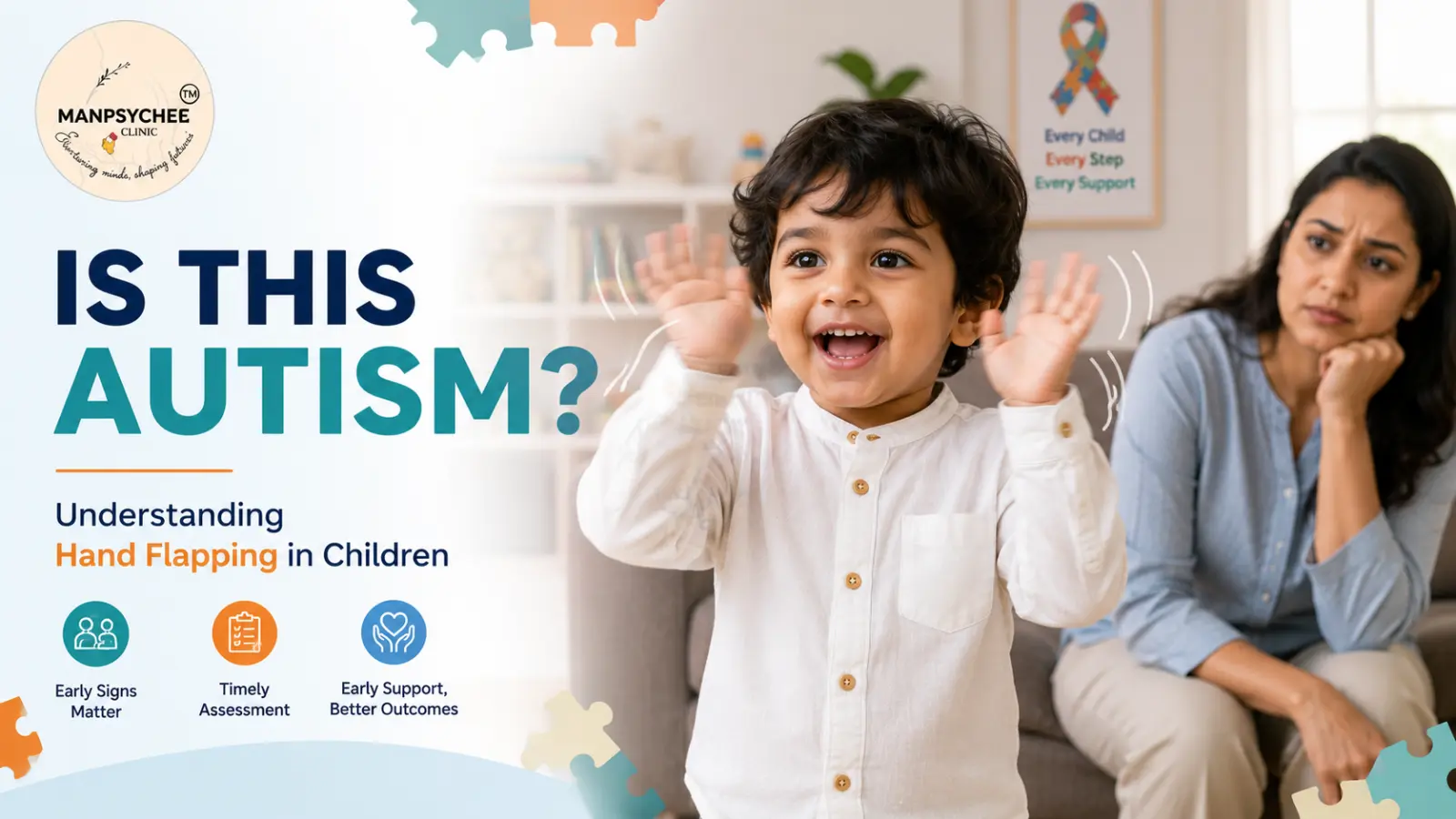
Hand flapping in children is a repetitive movement that often occurs during excitement, happiness, stress, or sensory stimulation. While hand flapping can be part of typical development, persistent hand flapping combined with speech delays, social communication difficulties, repetitive behaviors, or sensory differences may warrant a developmental assessment.
Why Can't My Child Sit Still? Causes, ADHD Signs & What Parents Can Do
Introduction
Many parents become concerned when they notice their child repeatedly flapping their hands.
Perhaps your child flaps their hands when excited, while watching a favorite cartoon, or when anticipating something they enjoy.
Naturally, questions begin to arise:
- Why does my child flap their hands?
- Is hand flapping normal?
- Does hand flapping mean autism?
- Should I be worried?
These concerns are understandable.
The reassuring news is that hand flapping alone does not automatically indicate Autism Spectrum Disorder (ASD).
However, understanding why hand flapping occurs and recognizing when it may be associated with developmental differences can help parents make informed decisions about their child's development.
This guide explains what hand flapping is, why children do it, when it is considered typical, and when professional assessment may be beneficial.
What Is Hand Flapping?
Hand flapping refers to repetitive movements of the hands, wrists, or arms.
Examples may include:
- Rapidly moving hands up and down
- Waving hands repeatedly
- Shaking wrists while excited
- Moving arms while jumping
- Flapping hands when happy or overstimulated
Hand flapping is considered a repetitive motor movement and can occur in both typically developing children and children with neurodevelopmental differences.
The behavior itself is not a diagnosis.
The meaning of hand flapping depends on the child's overall developmental profile.
Why Do Children Flap Their Hands?
Children may flap their hands for several different reasons.
1. Excitement and Happiness
One of the most common reasons for hand flapping is excitement.
Children may flap their hands when:
- Seeing a favorite toy
- Watching a preferred cartoon
- Meeting someone they love
- Anticipating a fun activity
In many cases, hand flapping is simply an expression of joy.
2. Emotional Expression
Young children often have limited language skills.
As a result, they may use body movements to express emotions such as:
- Excitement
- Frustration
- Surprise
- Anticipation
- Happiness
Hand flapping can be one way children communicate strong emotions.
3. Sensory Regulation
Some children use movement to help regulate sensory experiences.
Hand flapping may help them:
- Feel calmer
- Organize sensory information
- Reduce stress
- Cope with overwhelming situations
This is particularly common in children who are highly sensitive to sensory input.
4. Self-Stimulatory Behavior (Stimming)
Hand flapping is one form of what professionals call "stimming" or self-stimulatory behavior.
Other examples include:
- Rocking
- Spinning
- Humming
- Repeating sounds
- Twirling objects
Stimming can help children regulate emotions, attention, and sensory experiences.
Is Hand Flapping Always a Sign of Autism?
No.
This is one of the biggest misconceptions parents encounter online.
Many children flap their hands occasionally and never receive an autism diagnosis.
Hand flapping becomes more clinically significant when it occurs alongside other developmental concerns.
According to the Diagnostic and Statistical Manual of Mental Disorders (DSM-5), Autism Spectrum Disorder involves:
Social Communication Differences
Such as:
- Limited eye contact
- Delayed speech
- Reduced social interaction
- Difficulty sharing interests
Restricted and Repetitive Behaviors
Such as:
- Hand flapping
- Repetitive play
- Spinning objects
- Lining up toys
- Strong attachment to routines
Hand flapping alone cannot diagnose autism.
The overall developmental picture is what matters most.
Signs to Watch for Alongside Hand Flapping
Parents should consider whether other developmental differences are present.
Communication Delays
Your child may:
- Speak fewer words than expected
- Have difficulty expressing needs
- Show delayed language development
Reduced Eye Contact
Your child may avoid looking at others during play or conversation.
Limited Social Interaction
Children may:
- Prefer playing alone
- Show limited interest in peers
- Struggle to engage in social games
Poor Response to Name
A child may not consistently respond when called.
Repetitive Behaviors
Examples include:
- Lining up toys
- Spinning wheels
- Repeating phrases
- Watching the same activity repeatedly
Sensory Sensitivities
Your child may be unusually sensitive to:
- Loud sounds
- Bright lights
- Certain textures
- Specific food textures
Parent Observation Checklist
Ask yourself the following questions:
| Observation | Yes | No |
|---|---|---|
| Does my child respond to their name? | □ | □ |
| Does my child make eye contact? | □ | □ |
| Does my child use words appropriately for their age? | □ | □ |
| Does my child engage in pretend play? | □ | □ |
| Does my child enjoy interacting with others? | □ | □ |
| Does hand flapping occur very frequently? | □ | □ |
A single behavior rarely provides enough information to determine whether a developmental concern exists.
Patterns across multiple areas are far more important.
Scientific Explanation Behind Hand Flapping
Researchers believe repetitive movements serve several functions.
Emotional Regulation
Hand flapping may help children manage strong emotions.
Sensory Processing
Some children use movement to obtain predictable sensory feedback.
Neurological Regulation
Repetitive movements may support self-regulation of attention and arousal.
Research suggests that repetitive behaviors occur more frequently in neurodevelopmental conditions, including autism, but they are not exclusive to autism.
Age-Wise Understanding of Hand Flapping
Under 2 Years
Hand flapping can be observed in some infants and toddlers as part of normal excitement, sensory exploration, or emotional expression.
Many children naturally reduce this behavior as communication and emotional regulation skills develop.
2 to 4 Years
Hand flapping may still occur occasionally.
Parents should monitor social communication, play skills, and language development.
Preschool Years
Persistent hand flapping combined with developmental differences may warrant further evaluation.
School Age
If repetitive movements interfere with learning, social interaction, or daily functioning, professional assessment is recommended.
Real-Life Parent Example
A family visited K.S MannpsycheK Dwarka Mor concerned about their 2½-year-old daughter.
She frequently flapped her hands whenever she became excited.
The parents worried that this automatically meant autism.
During assessment, it became clear that she:
- Had age-appropriate speech
- Made good eye contact
- Enjoyed pretend play
- Engaged socially with family members
- Responded appropriately to her name
In her case, hand flapping appeared to be a temporary developmental behavior.
In contrast, another child who displayed frequent hand flapping also had speech delays, sensory sensitivities, repetitive play patterns, and social communication difficulties.
A comprehensive developmental evaluation supported an autism diagnosis.
The difference was not the hand flapping itself.
The difference was the child's overall developmental profile.
Myths vs Facts
| Myth | Fact |
|---|---|
| Hand flapping always means autism | False |
| Typical children can flap their hands | True |
| Autism diagnosis requires more than one symptom | True |
| Hand flapping may occur during excitement | True |
| Early assessment can be beneficial | True |
| All repetitive movements are abnormal | False |
Risk Factors Associated with Autism
Although hand flapping itself is not a risk factor, autism may be more likely in children with:
- Family history of autism
- Premature birth
- Low birth weight
- Certain genetic conditions
- Developmental delays
- Sensory processing differences
Risk factors increase probability but do not determine outcomes.
How Can Hand Flapping Affect a Child?
Occasional hand flapping typically has little impact on daily functioning.
However, if repetitive behaviors occur alongside developmental challenges, difficulties may arise in:
Communication
Language and social communication may be affected.
Social Skills
Children may struggle to engage with peers.
Learning
Flexibility in classroom activities may be reduced.
Emotional Regulation
Adapting to change may become more difficult.
Assessment and Diagnosis
If concerns exist, a professional evaluation may include:
Developmental History
Reviewing developmental milestones and parent concerns.
Parent Interviews
Understanding behavior across different settings.
Clinical Observation
Assessing communication, play, and social interaction.
Standardized Assessments
Using evidence-based developmental tools.
Multidisciplinary Evaluation
Professionals may include:
- Child Psychologist
- Developmental Pediatrician
- Speech Therapist
- Occupational Therapist
- Special Educator
Treatment and Support Options
If developmental concerns are identified, intervention may include:
Autism Assessment and Intervention Services
Individualized developmental support based on a child's strengths and challenges.
ABA Therapy
Evidence-based strategies that support communication, adaptive skills, and behavior development.
Speech Therapy
Supports language, communication, and social interaction skills.
Occupational Therapy
Addresses sensory processing, motor development, and daily living skills.
Special Education
Provides individualized educational support.
Behavior Therapy
Helps children develop adaptive and functional behaviors.
Home Strategies for Parents
Stay Calm
Avoid assuming the worst based on a single behavior.
Observe Patterns
Notice when hand flapping occurs and what triggers it.
Encourage Communication
Support language and social interaction throughout the day.
Join Your Child's Play
Participate in activities your child enjoys.
Monitor Developmental Milestones
Track progress in communication, play, social skills, and learning.
When Should Parents Seek Professional Help?
Consider seeking professional guidance if hand flapping occurs alongside:
- Speech delays
- Limited eye contact
- Reduced social interaction
- Sensory sensitivities
- Repetitive play patterns
- Developmental regression
- Delayed developmental milestones
Early assessment can provide clarity, reassurance, and access to appropriate support when needed.
Professional Support at MannpsycheK
At MannpsycheK, under the guidance of Dr. Saurav Deep, families receive comprehensive developmental and behavioral support through evidence-based assessment and intervention services.
Our services include:
- Autism Assessment
- Autism Assessment and Intervention Services
- ABA Therapy
- Speech Therapy
- Special Education
- Learning Disability Assessment
- ADHD Assessment
- Behavior Therapy
- Developmental Screening and Early Intervention
Conclusion
Hand flapping is a behavior that can occur in both typically developing children and children with developmental differences.
The presence of hand flapping alone does not mean autism.
Parents should focus on the child's overall development, including communication, social interaction, play skills, and behavior patterns.
When concerns exist, professional guidance can provide clarity and reassurance.
Seeking assessment early is a proactive step that can help families better understand and support their child's developmental journey.
Book a Developmental Assessment at MannpsycheK
If you are concerned about your child's hand flapping, communication skills, social interaction, behavior, or developmental milestones, professional guidance can help.
At K.S MannpsycheK Dwarka Mor, we provide:
- ✔ Autism Assessment
- ✔ Developmental Assessment
- ✔ ABA Therapy
- ✔ Speech Therapy
- ✔ Special Education Services
- ✔ Learning Disability Assessment
- ✔ ADHD Assessment
- ✔ Behavior Therapy
- ✔ Parent Guidance and Counseling
Our multidisciplinary team is committed to helping children build communication, learning, social, and adaptive skills through evidence-based interventions.
Book a consultation today and take the first step toward understanding and supporting your child's developmental needs.
Frequently Asked Questions
Q1. Does hand flapping always mean autism?
A1. No. Hand flapping alone does not automatically indicate autism. Many infants and toddlers flap their hands when excited, happy, or emotionally stimulated. It becomes more clinically significant when it occurs alongside speech delays, reduced eye contact, limited social interaction, repetitive behaviors, sensory sensitivities, or developmental delays.
Q2. At what age is hand flapping considered normal?
A2. Hand flapping may be seen in some children during infancy and toddlerhood, particularly when they are excited, happy, or overstimulated. Many children gradually reduce the behavior as language, social communication, and emotional regulation skills develop.
Q3. Why does my child flap their hands when excited?
A3. Many children use body movements to express strong emotions. Hand flapping may occur during excitement, happiness, anticipation, or sensory stimulation. It can be a normal way for young children to release energy before they have the language skills to express those emotions verbally.
Q4. What other signs should I watch for besides hand flapping?
A4. Parents should observe communication skills, eye contact, social interaction, pretend play, response to name, sensory sensitivities, and developmental milestones. Hand flapping combined with difficulties in these areas may indicate the need for a professional developmental assessment.
Q5. Should I stop my child from hand flapping?
A5. Generally, no. Unless the behavior is harmful or significantly interferes with daily functioning, parents should focus on understanding why it occurs rather than trying to stop it. Supporting communication, emotional regulation, and developmental growth is often more beneficial than suppressing the movement.