Home › Guidance For Parents › My Child Is Addicted to Mobile: Signs, Causes & What Parents Can Do
My Child Is Addicted to Mobile: Signs, Causes & What Parents Can Do
Many parents are facing the same problem today:
Why Is My Child Not Listening? Common Causes and Solutions for Parents
How Cognitive Therapy Helps Manage Anxiety, Stress, and Negative Thinking
"My child will not leave the mobile phone."
What starts as a way to keep a child busy often turns into daily conflict, emotional outbursts, tantrums, and dependency on screens. If your child becomes angry when the phone is taken away, ignores instructions, refuses other activities, or spends hours on mobile screens, it may be more than just a habit.
Parents often search for answers online using phrases like:
- mobile addiction in children
- my child is addicted to mobile
- child not listening because of mobile
- screen time problem in children
- child psychologist in Dwarka
- child development centre in Dwarka
This guide explains why mobile addiction happens, the warning signs parents should watch for, and what can be done to help children use screens in a healthier way.
Is Mobile Addiction in Children Really a Problem?
Yes, it can be.
A mobile phone is not harmful by itself. The problem begins when screen use becomes excessive and starts affecting:
- behaviour
- sleep
- attention
- speech
- learning
- social interaction
- emotional control
When a child depends on a mobile for comfort, entertainment, or distraction all the time, it can interfere with normal development.
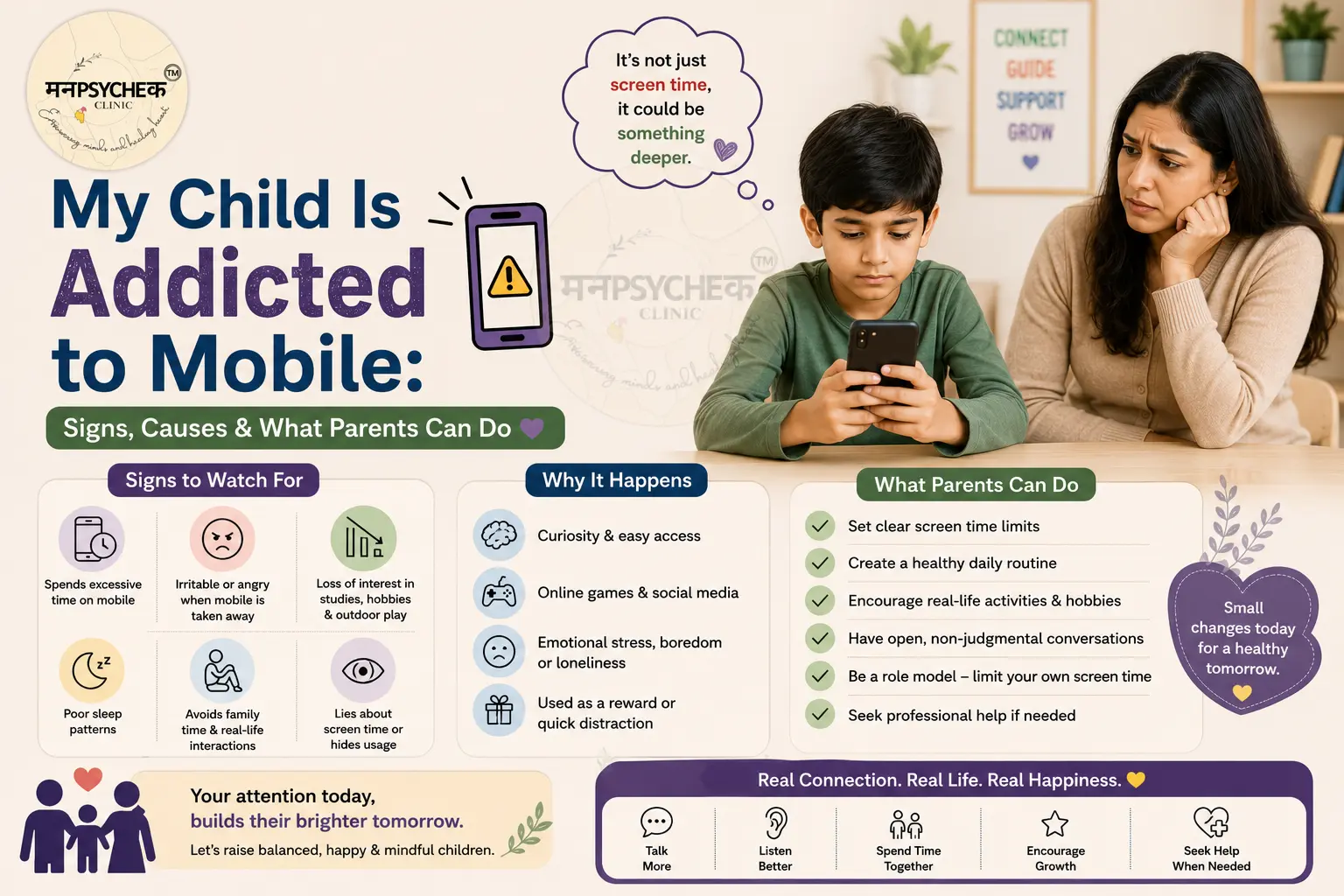
Signs Your Child May Be Addicted to Mobile
Not every child who likes a phone is addicted. The concern rises when the behaviour becomes difficult to control.
Common warning signs include:
- anger or crying when the phone is taken away
- refusing to eat, sleep, or study without the phone
- spending long hours on screens every day
- losing interest in toys, play, or social interaction
- becoming irritable or aggressive after screen time
- not listening to parents during mobile use
- needing the phone to stay calm
- hiding screen use from parents
If these signs are happening often, it is worth taking the issue seriously.
Why Do Children Become So Attached to Mobile Phones?
Children are drawn to phones because they are fast, colorful, rewarding, and easy to use. Unlike real-life activities, mobile screens give instant stimulation.
Common reasons include:
- boredom
- lack of structured play
- parents using mobile as a calming tool too often
- limited outdoor activity
- difficulty managing emotions
- imitation of adults who use phones frequently
- access to games, videos, and short-form content
In many homes, mobile use starts as a convenience and gradually becomes a coping pattern.
What Mobile Addiction Can Do to a Child
Too much screen time can affect a child in several areas.
1. Attention Problems
Children may become less able to focus on homework, conversations, or classroom tasks because their brain gets used to quick stimulation.
2. Behaviour Issues
Excessive screen time can lead to:
- tantrums
- defiance
- low frustration tolerance
- aggression
- poor self-control
3. Sleep Disturbance
Using a mobile before bed can make it harder for children to fall asleep and stay asleep.
4. Speech and Communication Delays
Children who spend too much time on screens may speak less, interact less, and miss opportunities to practice language.
5. Reduced Social Skills
When screen time replaces real interaction, children may struggle with:
- eye contact
- conversation
- sharing
- turn-taking
- peer play
6. Academic Difficulty
A child who is overexposed to mobile screens may find it harder to sit through lessons, complete homework, or follow instructions.
Mobile Addiction vs Normal Screen Use
The real question is not whether a child uses a phone. Most children do.
The real question is:
Does screen use interfere with healthy daily functioning?
Normal use:
- limited duration
- controlled by parents
- does not trigger major meltdowns
- does not affect sleep, school, or behaviour
Concerning use:
- child cannot stop easily
- conflicts happen daily
- other activities are ignored
- child becomes emotionally dependent on screens
That is when it becomes a problem.
How Parents Can Reduce Mobile Addiction
Many parents try to solve the problem by suddenly snatching the phone away. That usually backfires.
A better approach is:
Set clear rules
Decide when and how long the phone can be used.
Be consistent
If the rule changes every day, the child will keep testing boundaries.
Replace the phone with other activities
Children need alternatives such as:
- outdoor play
- drawing
- puzzles
- reading
- sports
- family games
Use screen time as a privilege, not a default
The child should understand that screen time comes after responsibilities.
Avoid using the phone as the main calming tool
If every emotional moment is handled with a mobile, dependency grows faster.
When Mobile Use May Be Covering a Bigger Issue
Sometimes a child is not addicted to mobile just because of the phone itself. The screen may be hiding a deeper issue.
A child may rely on mobile use because of:
- anxiety
- speech delay
- ADHD
- autism-related difficulties
- poor social skills
- emotional regulation problems
- boredom due to lack of stimulation
In such cases, the screen is not the root cause. It is a coping mechanism.
That is why professional assessment can be useful when the problem is severe.
When Should Parents Seek Professional Help?
Consider support from a child psychologist in Dwarka if your child:
- becomes aggressive when the phone is removed
- refuses normal play and interaction
- has attention issues in school
- shows speech delay
- has frequent emotional outbursts
- avoids social contact
- cannot follow daily routines without the mobile
A professional can help determine whether the issue is mainly behavioural, developmental, emotional, or related to attention and self-regulation.
How a Child Development Centre Can Help
A good child development centre in Dwarka can assess the child more holistically.
Support may include:
- child behaviour assessment
- attention and hyperactivity evaluation
- speech and language review
- parent counselling
- behaviour therapy
- social skills support
- developmental guidance
This is especially helpful when screen dependency is linked with broader developmental concerns.
Why Families in Dwarka Seek Help Early
Parents in Dwarka often search for:
- child psychologist in Dwarka
- child development centre in Dwarka
- behaviour therapy in Dwarka
- ADHD assessment in Dwarka
- speech delay support in Dwarka
because they want practical help before the habit becomes stronger.
Early support can improve:
- attention
- sleep
- behaviour
- family communication
- learning
- emotional regulation
The sooner the pattern is addressed, the easier it is to change.
Why Families Choose KS Mannpsyche India Private Limited
Families looking for a child psychologist in Dwarka often want a place that understands both behaviour and development.
At KS Mannpsyche India Private Limited, children can receive:
- child behaviour therapy
- parent guidance
- developmental assessment
- ADHD support
- autism support
- speech and communication-related guidance
- emotional regulation support
Under the guidance of Saurav Deep, RCI Certified Psychologist and Behaviour Therapist, families receive individualized, evidence-based support focused on improving child behaviour, attention, communication, and daily functioning.
Final Thoughts
Mobile addiction in children is not just a modern parenting annoyance. When left unchecked, it can affect a child’s behaviour, attention, sleep, learning, and social development.
The goal is not to fight the phone alone. The goal is to understand why your child is dependent on it and what healthier alternatives need to be built.
If screen time is creating daily conflict, emotional outbursts, or developmental concerns, professional support from a child psychologist in Dwarka or a child development centre in Dwarka can help you get back control.
Frequently Asked Questions
Q1. Is mobile addiction in children real?
A1. Yes. When screen use becomes excessive and affects behaviour, sleep, learning, or emotional health, it becomes a real concern.
Q2. Where can I find help for mobile addiction in Dwarka?
A2. Parents can seek support from a child psychologist in Dwarka or a child development centre in Dwarka for assessment and behaviour guidance.
Q3. Can mobile addiction cause speech delay?
A3. Excessive screen time may reduce real-life interaction, which can affect speech and language development.
Q4. What is the best way to reduce screen time?
A4. Set clear rules, stay consistent, offer better alternatives, and avoid using the phone as a reward for every situation.
Q5. Should I consult a child psychologist if my child cannot leave the mobile?
A5. If the child becomes aggressive, highly dependent, or shows behavioural or developmental concerns, professional help is a good idea.